

As part of INTX being consolidated into Deribit, and the many new perpetual instruments this brings with it, Deribit has reworked how the margin requirements are calculated for standard margin accounts. This affects how much leverage traders can use, and how this varies based on the size of the position, and instrument traded. This article will outline how the new model works.
Note: This only applies to futures and perpetuals. Options have their own calculation which remains unchanged at this time.
Old method
The old method calculated initial margin (IM) and maintenance margin (MM) according to the following formulas.


Where a and B are parameters set depending on the instrument in question.
New method
From August 2026, the following formulas will replace the old method.


Where L(N) is the available IM leverage for the given coin and position size, calculated as:

Where:
C1 = Start leverage
C2 = End leverage
C3 = Constant maximum leverage range
C4 = Steepness factor
N = Position size in the account, measured in units of the underlying e.g. BTC
NMax = Maximum allowed position size, measured in units of the underlying e.g. BTC
Instrument tiers
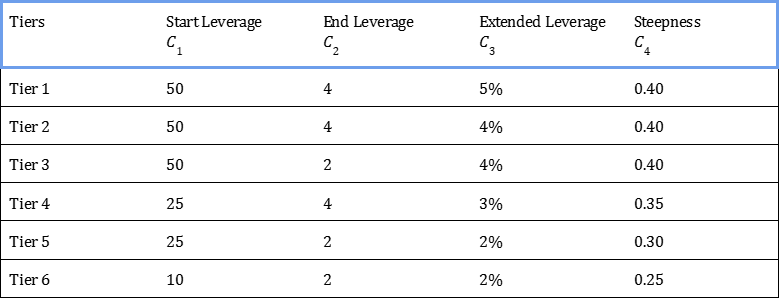
The values for C1, C2, C3, and C4, are set according to which tier an instrument is in. The parameter values for each tier are shown in the following table:
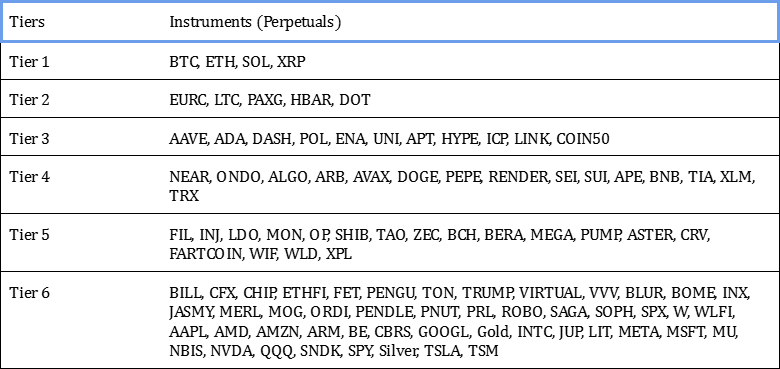
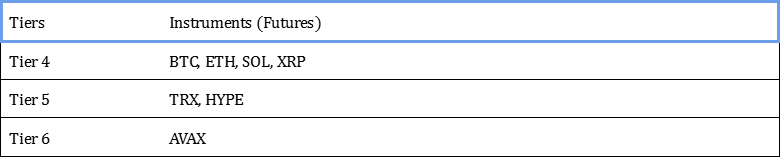
And the instruments are assigned to the tiers as follows:
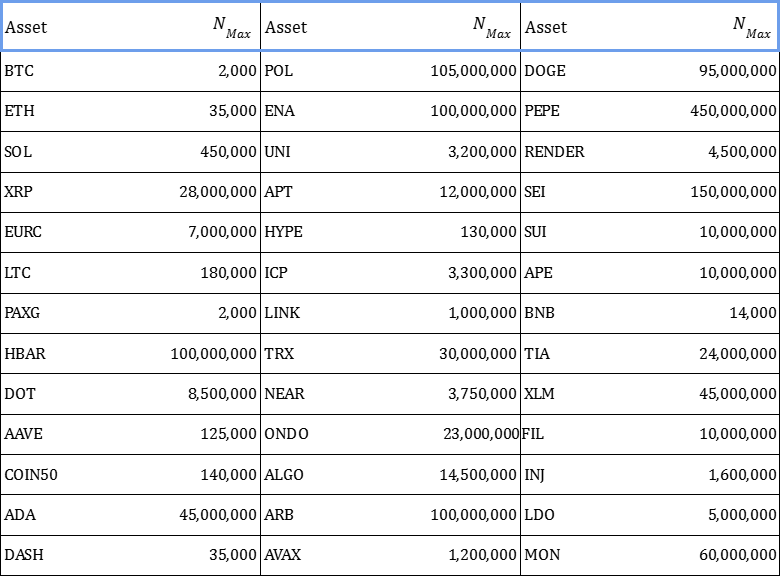
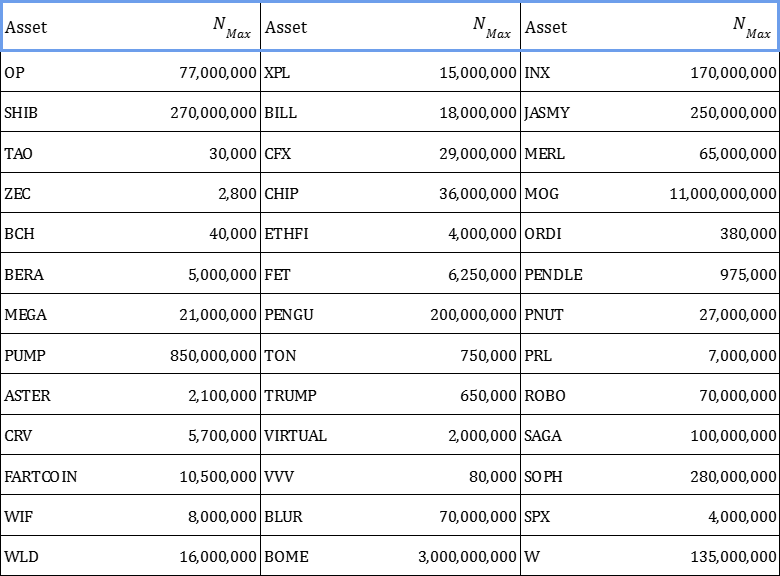
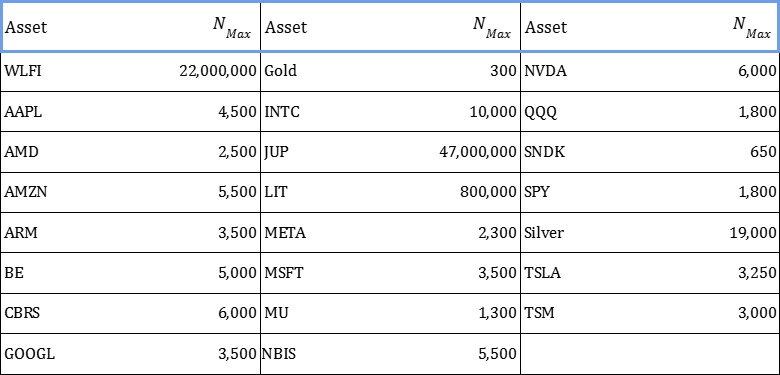
Maximum position sizes (NMAX)
The maximum position size, measured as an amount of the underlying unless mentioned otherwise, is as follows:
Calculation example
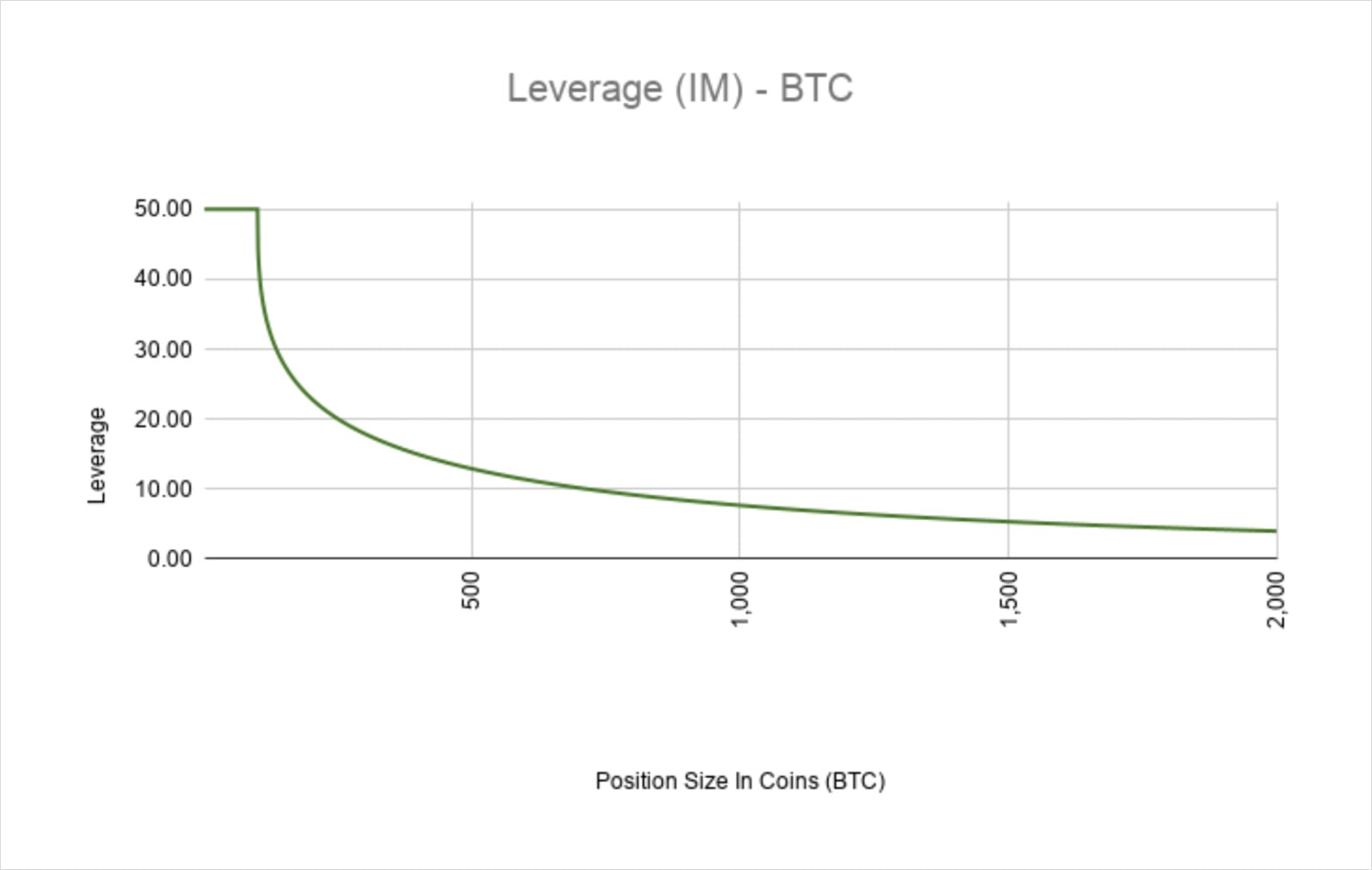
Let’s say we are trading a BTC perpetual. BTC perpetuals are a tier 1 instrument, so from the above tables, we know that:
C1 = 50
C2 = 4
C3 = 5%
C4 = 0.4
NMAX = 2,000
If we assume a position size of 150 BTC (N = 150), we can calculate the maximum IM leverage with the following formula:



So with a position size of 150 BTC, we can open a position at roughly 27.73x leverage. More generally, the available leverage for BTC given the stated parameters can be seen on the following chart.
Risk controls
The new parameters give the Deribit risk team the necessary control over the available leverage for each instrument across all possible position sizes. C1 and C2 control the allowed leverage at the smallest and largest position sizes respectively. C3 controls at what position size the allowed leverage starts to drop from the maximum. C4 controls the steepness of that drop. Finally, NMAX sets a hard limit on the maximum position size per instrument for a single account.
Summary
This new method for calculating IM and MM for standard margin accounts allows Deribit to better cater for the many new perpetual instruments that are joining the platform, by giving the Deribit risk team more precise control over the available leverage on each. The new calculations will go into effect some time in August 2026.
AUTHOR(S)

We are the best resource for Crypto Derivatives trading. Deribit is not available in the United States or other restricted countries.