

What is Volatility, how can you trade it and why would you?
In a few weeks time Deribit will introduce DVOL Futures. DVOL Futures are contracts that trade on the market volatility as measured by the value of options which expire in 30 days. We will commence with a single BTCDVOL contract, based on Bitcoin Volatility. Later also ETH contracts will be listed and there will be a few different expiries for both products.
What is Volatility?
Volatility is a measurement of how markets behave. Let’s assume we are experiencing a very quiet period where not much trading takes place. The public is not really interested in either buying or selling assets, traders are quite inactive and as a result the market will be very rangebound and doesn’t show much fluctuation. Such a market we call a low volatility environment.
When a market moves drastically up and/or down we call it a high volatility environment.
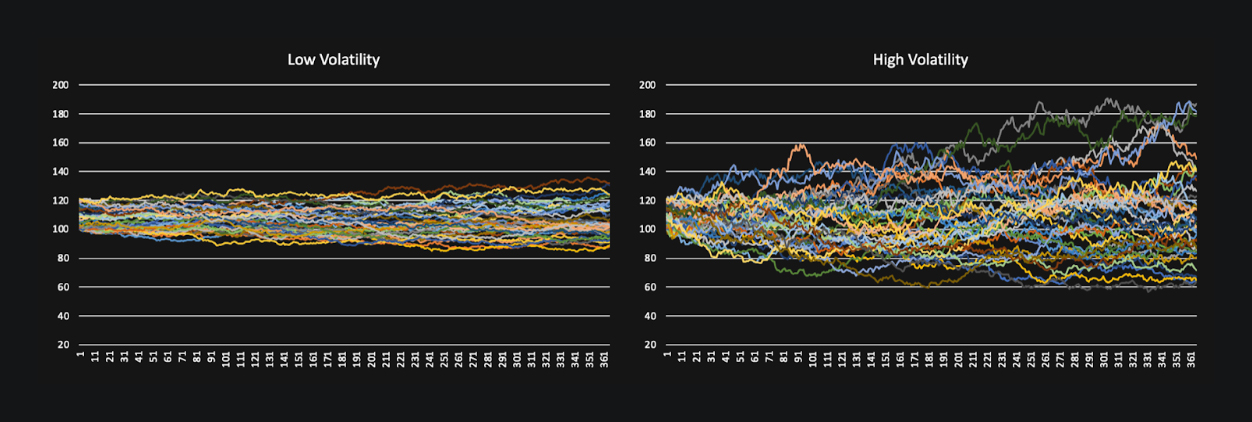
By means of a simple calculation we can generate a number which expresses the amount of Volatility observed in the market.
This number is important for option traders since prices of options heavily depend on it. The higher the Volatility the more expensive options prices will be and vice versa.
Some of you may have heard about VIX Futures (based on the VIX Index); a very popular and liquid product with which one can trade the Volatility of the SP500 Index. The VIX Index is a calculation which uses options prices to compute the expected Volatility for the coming 30 days.
The difference between the before mentioned calculation and the VIX calculation is that the former is based on the past (called Historical Volatility) and that the VIX is based on the time ahead (Implied Volatility).
Exactly the same will apply for BTC & ETH DVOL Futures (based on the DVOL Index).
Why would you trade them?
When having intermediate to good options knowledge you most probably already figured out that you can create a volatility position with either options or Volatility Futures. Then why would you trade the latter?
The answer is actually fairly simple:
When looking for volatility exposure, trading Volatility Futures is by far the easiest way because composing a similar position with options requires a sophisticated options trading approach. One then needs to take into account that there might be a need for delta, gamma and vega hedging. Next to that, rebalancing the options portfolio can become very costly.
Trading options against Volatility Futures is only recommended for (semi) professional options traders.
Calculation Method
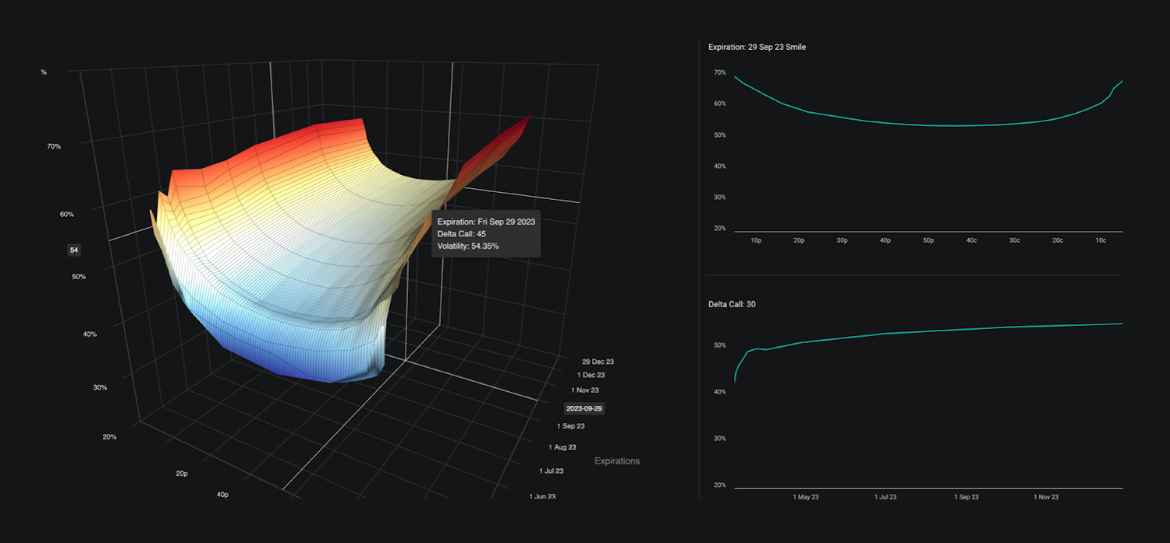
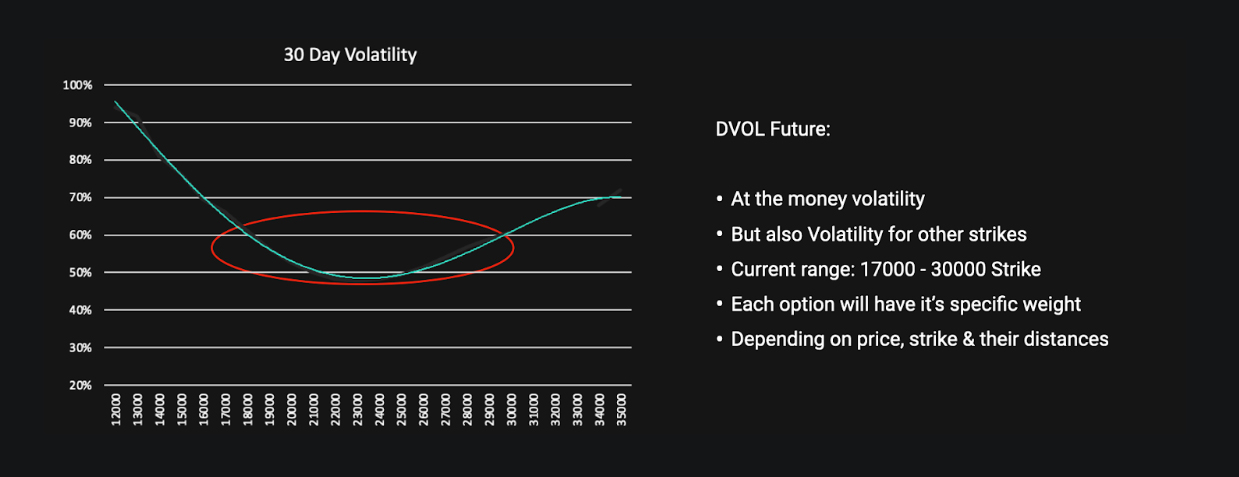
DVOL calculation is not only based on options which are at the money (where the strike is approximately equal to the underlying), but also on other strikes. Because of the elevated prices of so called out of the money options, DVOL will have a slightly higher value as compared to the at the money options. Every strike will have its own specific weight. The tinies (options with very low value) will be disregarded in the calculation. In the current market options between the 17000 and 30000 strike will be applicable for the computation.
If prices of out of the money options (as compared to the at the money options) will increase further, the level of DVOL will be higher and the other way around (this is what is called the Skew/Smile effect).
Opportunities
Volatility has a tendency to return to an equilibrium; this is what is called reversion to the mean. This is a level where we can expect business as usual and where everyone feels comfortable/complacent. Quite often this level is around the long term mean of Volatility. When events take place it might shoot up, when the market participants are disinterested, liquidity is low and not much happens one can expect Volatility to come off. But …. In time it will come back; how quick this will happen is called the mean reversion rate.
You can trade this, however timing is crucial.
Two major events of the past months:
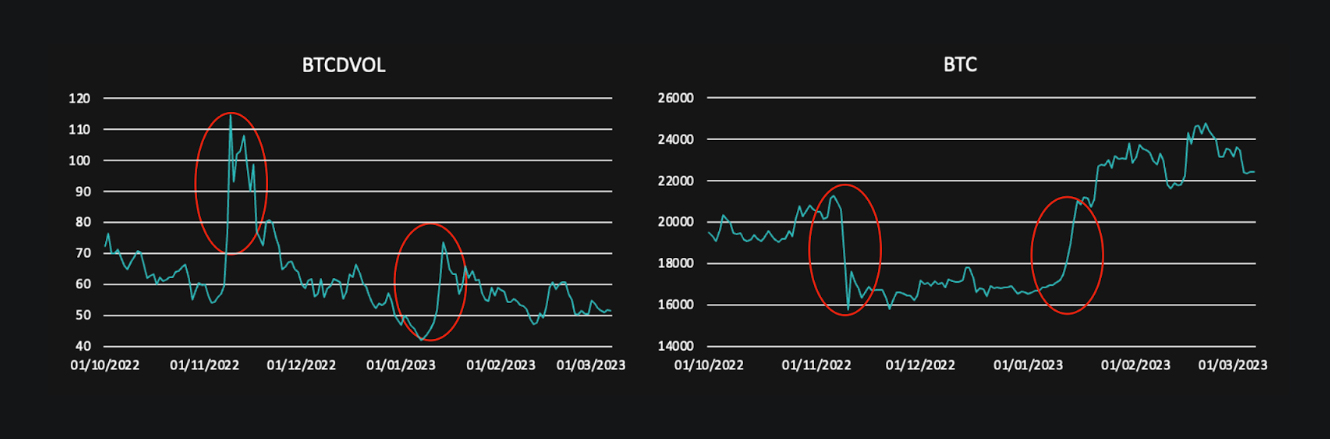
In November we had the FTX debacle, causing BTC to drop by a merely 20% and bringing BTCDVOL towards the 110-120 region, to fall back considerably in just a few days. It created an opportunity, but admittedly, you need to have balls to sell into a Volatility frenzy at a time when one of the largest crypto exchanges defaults.
After the FTX event the market was very unanimated. People were on the sidelines awaiting macro- economic news and further implications of the FTX demise. Nothing happened and consequently Volatility dropped to unprecedented levels (40- ish). Mid January BTC returned to levels where it was before the FTX event in just a few trading sessions. This caused DVOL to jump towards 70.
Since the Volatility of DVOL Futures is much higher than the Volatility of BTC/ETH itself we offer a lower leverage, up to 10 times, as compared to BTC/ETH Futures which can be leveraged up to 50 times.
Related information
Official Announcement about DVOL BTC Futures: Link.
DVOL Whitepaper: Link.
BTC DVOL Futures Product Specifications: Link.
Official DVOL Deck Overview: Link.
AUTHOR(S)

We are the best resource for Crypto Derivatives trading. Deribit is not available in the United States or other restricted countries.
THANKS TO
Pierino Ursone, Deribit – Head of Options